

How to Join Pak Navy Special Branch of Psychologists | Eligibility | Test Pattern
The Pak Navy Special Branch of Psychologists through Short Service Commission is an esteemed career path that combines psychological expertise with military service. These psychologists play a crucial role in supporting the mental well-being and performance of naval personnel.
In this comprehensive article, we delve into the various aspects of this unique career, including eligibility criteria, job responsibilities, and the impact these professionals have on the Pak Navy. Whether you are aspiring to be a psychologist in the Navy or simply curious about this field, this article aims to provide valuable insights and shed light on the critical role played by these professionals.
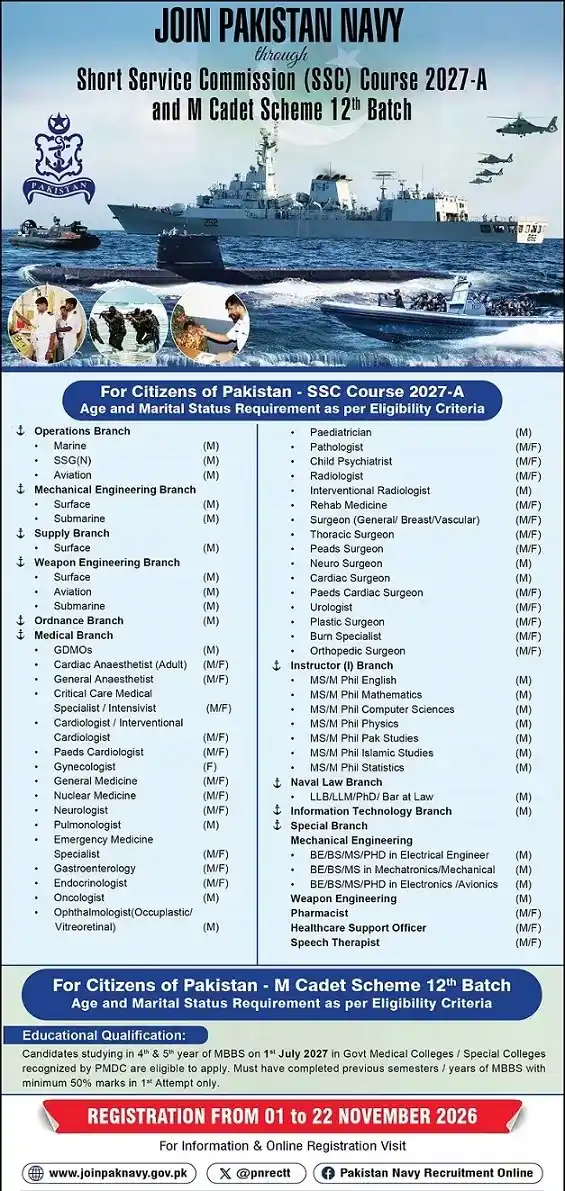
- Online Apply for Registration in Navy Special Branch (Psychologists): 01 Nov, 2026
- Last Date of Online Registration of Psychologists in Navy Special Branch: 22 Nov, 2026
Eligibility Criteria of Pak Navy Psychologists Job
The Pak Navy Special Branch of Psychologists through Short Service Commission is a specialized division within the Pakistan Navy that comprises trained psychologists. These psychologists are recruited through the Short Service Commission, which allows them to serve for a limited duration while making significant contributions to the mental well-being and performance of naval personnel.
They employ their expertise in psychological assessments, counseling, and research to ensure the overall resilience and effectiveness of the Navy’s human resources. If you want to apply for Commission Officer in Pak Navy through Short Service Commission as a Psychologist then you must fulfill the following conditions / criteria.
- Age Limit: 20- 26 Years (On the first day of month in which a candidate joins the training establishment or a specific date promulgated by NHQ)
- Height: Male (5’4″ or 162.5 cm) and Female (5’, or 152.4 cm)
- Physical Fitness: Prospective candidates must meet the physical fitness standards set by the Pakistan Navy.
- Nationality: Only Pakistani citizens can apply for this commission.
- Educational Qualifications: Applicants should have a minimum of a Master’s degree in Psychology from a recognized university. Specializations in clinical, counseling, or organizational psychology are highly valued.
How to Apply Online for Pak Navy Psychologist ?
To apply online for a position as a psychologist in the Pakistan Navy, you can follow these general steps which are typical for military recruitment. Please note that the specific details can vary, so it’s important to check the Pakistan Navy’s official recruitment website or the latest advertisement for the most accurate and up-to-date information.
Steps to Apply Online:
- Visit the Official Recruitment Website: Go to the official Pakistan Navy recruitment website. The URL for this website is typically announced in advertisements or can be found through a simple search for “Join Pak Navy.”
- Check Eligibility Criteria: Before applying, carefully read the eligibility criteria specific to the psychologist position as per given advertisement. This usually includes educational requirements (such as a degree in psychology), age limits, and other necessary qualifications.
- Registration: If you meet the eligibility criteria, proceed with the online registration. This step requires you to fill out a form with your personal details, educational background, and any other required information.
- Submission of Documents: Upload the necessary documents, which typically include academic certificates, identification documents, and any certificates of professional experience. Download the registration slip and get its print for test date and time.
- Entrance Test: After registration, you may need to appear for an entrance test that could include general aptitude tests and professional knowledge tests related to psychology.
- Interview and Medical Examination: If you pass the entrance test, the next steps usually involve an interview and a preliminary medical examination.
- ISSB Tests: For some positions, including those in more specialized fields like psychology, you might also need to clear the Inter-Services Selection Board (ISSB) tests.
- Final Selection: After clearing all the tests and interviews, the final selection is made based on your performance across all stages.
- Training: Upon selection, you might undergo specific training relevant to your role as a psychologist in the Navy.
Test Pattern for Navy Psychologists Initial Tests
Following test pattern is being used by Pak Navy through Shot Service Commission every year, in which candidates have to follow the test series to pass the initial stage.
- Intelligence Test (100 Question in 40 Min and Pass marks are 50%)
- Academic Test (Total 75 Questions in 35 Min with pass Mark 50%)
Syllabus of Psychologists Initial Tests in Pak Navy
Main topics which have been covered in the academic paper of psychologist are given below;
1. Introduction to Psychology: An overview of the field of psychology, its history, major theories, and key concepts.
2. Biological Bases of Behavior: Study of the brain, nervous system, and how they influence behavior and mental processes.
3. Developmental Psychology: The study of human development across the lifespan, including physical, cognitive, and socio-emotional changes.
4. Cognitive Psychology: Examination of mental processes such as memory, perception, thinking, and problem-solving.
5. Social Psychology: Exploration of how social influences impact individual behavior, attitudes, and beliefs.
6. Abnormal Psychology: Study of psychological disorders, their classification, causes, and treatment approaches.
7. Personality Psychology: Analysis of different theories of personality and how individual differences impact behavior.
8. Research Methods in Psychology: Introduction to research design, data collection, and analysis methods used in psychological studies.
9. Psychological Testing: Understanding psychological assessment, including intelligence and personality testing.
10. Industrial and Organizational Psychology: Exploration of psychological principles applied to workplace settings, including employee motivation, leadership, and organizational behavior.
11. Educational Psychology: Study of learning theories, instructional methods, and factors influencing learning outcomes.
12. Health Psychology: Understanding the connection between psychology and physical health, including stress, coping mechanisms, and health behavior.
13. Counseling Psychology: Introduction to counseling theories and techniques used in therapeutic interventions.
14. Neuropsychology: Examination of the relationship between brain function and behavior, particularly in cases of brain injury or neurological disorders.
15. Human Development and Behavior in Pakistan: An examination of cultural and societal influences on human behavior specific to Pakistan.
Benefits of Joining Pak Navy as Psychologist
Benefits of Joining Pak Navy
- Professional Growth Opportunities: Continuous training and development opportunities help in enhancing professional skills and knowledge in psychology and related fields.
- Job Stability and Security: A career in the Pakistan Navy offers job security, which is highly valued in today’s job market.
- High Social Esteem: Working as an officer in the Pakistan Navy comes with significant respect and prestige, reflecting a noble and impactful service role.
Salary and Allowances
- Competitive Salary Package: The pay scale for psychologist officers in the Pakistan Navy is competitive, matching the best governmental positions. Normal salary after passing out from Naval Academy, ranges between 60,000 rupees to 90,000 rupees.
- Various Allowances: This includes housing allowance, transport allowance, medical allowance, and uniform allowance, which significantly enhance the basic salary.
- Incentive Pay for Advanced Degrees: Additional salary incentives are provided for holding higher degrees or specialized certifications in psychology.
Facilities Provided by Pak Navy
- Accommodation: Housing facilities or allowances are provided, ensuring comfortable living conditions for officers and their families.
- Medical Care: Comprehensive medical facilities are available to officers and their immediate family members, ensuring their health and well-being.
- Educational Opportunities for Dependents: Substantial concessions are offered for children’s education at Navy-run or associated educational institutions.
- Access to Recreational Facilities: Officers enjoy access to various sports and recreational facilities, which help in maintaining a balanced lifestyle.
Promotion and Career Advancement
- Clear Promotion Path: Psychologist officers in the Pakistan Navy have a structured career path, with promotions based on performance, seniority, and educational advancements. Promotions move through ranks such as Lieutenant, Commander, Captain, up to higher echelons.
- Leadership Opportunities: As officers ascend through ranks, they have opportunities to undertake significant leadership roles within the psychological services of the Navy, influencing broader policies and practices.
Additional Facilities
- Travel Opportunities: The role includes opportunities for national and international travel, often associated with conferences, training, or inter-service exchange programs.
- Retirement Benefits: Robust pension schemes and post-retirement benefits ensure long-term financial security.
Impactful Work
- Direct Contribution to Naval Personnel Well-being: Officers in this role provide critical psychological support, enhancing the mental health and operational readiness of Navy personnel.
Official Armed Forces Career Portals
Comprehensive Test Practice And Study Guides
Military Ranks And Compensation Structures
Expert Guide To Mastering The Navy Special Branch Psychologists Selection Process
Navigate your professional assessments, clinical tests, and selection board interviews with structured strategies engineered by Shaheen Forces Academy.
M sc psychology eligibility criteria for pak navy short service commission
To qualify for Short Service Commission (SSC) entry as a Psychologist in the Pakistan Navy, candidates must meet strict academic prerequisites. Review this qualification checklist:
- Required Degree: Master’s degree (16 years of education) in Psychology or Applied Psychology from an HEC-recognized university. Clinical psychology specialization is preferred.
- Minimum CGPA / Marks: At least 2.5/4.0 CGPA or a minimum of 60% marks in annual system examinations.
- Age Limit: Typically ranges between 23 to 28 years as of the targeted induction date. Always verify specific age relaxations on the official recruitment portal.
Pak navy psychologist initial test intelligence and clinical syllabus
The initial screening test for professional psychologist branches combines general intelligence with core subject knowledge. Structure your revision around this weighted model:
Total Test Structure = Intelligence Testing (Verbal & Non-Verbal) + Professional Subject MCQs (Clinical & General Psychology)
Breakdown: Intelligence sections carry roughly 50 to 60 questions focused on logical reasoning, while the professional section contains specialized MCQs covering psychological theories, psychometrics, and mental health assessment. Aim for an overall accuracy rate above 70% to secure shortlisting.
Intelligence test verbal and non verbal tips for navy psychologist branch
Computer-based intelligence tests require rapid decision-making under tight time constraints. Use this time allocation formula:
Target Time per MCQ = Total Time (30 mins) / Total Questions (80) = 22.5 Seconds Max
Strategy: Adopt the Two-Pass Method. Pass 1: Solve direct analogies, coding, and spatial series instantly, skipping questions exceeding 15 seconds. Pass 2: Revisit flagged complex items. There is no negative marking, so never leave any options blank.
Word association test tips for navy psychologist candidates
Psychological batteries feature the Word Association Test (WAT), where candidates write the first thought or sentence provoked by stimulus words. Follow this response checklist:
- Speed & Spontaneity: You are allotted only 5 to 6 seconds per word. Write the first meaningful sentence that comes to mind.
- Positive Construct: Avoid negative, defeatist, or overly morbid sentences. Focus on themes of courage, leadership, stability, and problem-solving.
- Authenticity: Keep sentences natural rather than rehearsed clichés to maintain psychological profile consistency.
Picture story writing tips for navy psychologist screening tests
The Thematic Apperception Test (TAT) requires writing a structured story based on a hazy projected image. Use this four-part narrative framework:
[Background: What led up to the scene] → [Present: What characters are feeling/doing] → [Action: How they resolve the challenge] → [Outcome: A positive, constructive conclusion]
Checklist: Limit stories to 5–6 sentences. Ensure the protagonist displays initiative, emotional resilience, and clear goal-directed behavior.
Clinical psychology practical scenario questions in pak navy interview
Selection boards evaluate professional competency by presenting simulated service-related psychological scenarios. Prepare using this analytical framework:
- Behavioral Observation: Identify primary indicators of acute stress, combat fatigue, or adjustment disorders in personnel.
- Ethical Counseling: Apply professional confidentiality limits while prioritizing operational safety and unit cohesion.
- Structured Intervention: Propose evidence-based psychological first aid and referral protocols suited for military environments.
Pak navy professional branch initial medical test eyesight and physical rules
Initial medical screenings at Recruitment & Selection Centres enforce strict physical and optical guidelines for professional commissioned officers. Follow these standards:
- Visual Acuity: Requires clear vision limits (allowable minor specs tolerance up to ±1.5 diopters depending on branch directives).
- Color Perception: Must pass Ishihara color blindness testing; complete color accuracy is mandatory for accurate clinical testing and profiling duties.
Pak navy special branch psychologist interview questions by selection board
The final interview conducted by the senior selection board evaluates your professional demeanor, communication, and emotional stability. Prepare using this framework:
- Self-Introduction: Deliver a polished 60-second summary covering your academic training, clinical internship experience, and motivation to serve in the Navy.
- Defense Psychology: Be ready to discuss the role of psychological testing in military selection and stress management.
- Composure: Answer cross-questioning calmly, demonstrating high emotional intelligence and leadership alignment.
Psychiatric evaluation standards during initial medical board pak navy
Medical boards include a dedicated psychiatric evaluation to rule out underlying personality disorders or emotional instability. Note these key criteria:
- Emotional Resilience: Assessed via structured clinical interviews to verify stress tolerance under high-pressure environments.
- History Screening: Complete transparency regarding past neurological treatments, chronic anxiety, or psychological counseling is mandatory. Any concealment during medical screening leads to permanent disqualification.
Naval headquarters islamabad psychologist branch reporting procedure
Upon clearing preliminary tests, professional interviews, and final merit evaluations, candidates receive joining directives. Follow these compliance steps:
- Verify final merit listing on the official Pakistan Navy recruitment web portal.
- Download your call-up letter and assemble verified educational transcripts, HEC degree attestations, and CNIC copies.
- Report to the designated naval selection center or Naval Headquarters (NHQ) Islamabad on the exact timestamp indicated for commissioning documentation.
Follow Shaheen Forces Academy Online For Free MCQs, Notes And Job Updates
Stay connected with our official groups and channels to get daily test preparation material, past papers, ISSB tips and latest announcements for Pakistan Army, Navy, PAF, Cadet College and CSS aspirants.


