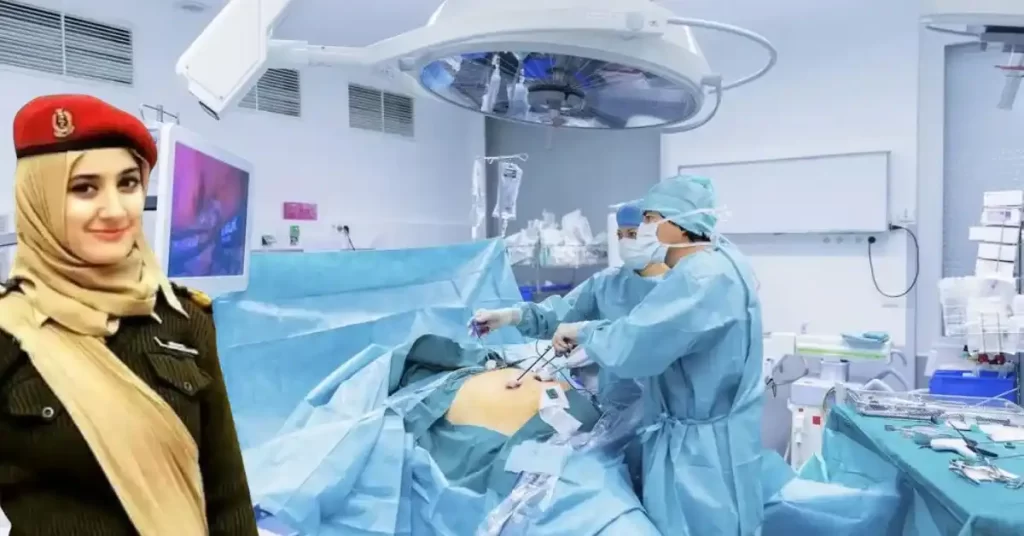
Join PAF Aeronautical Engineering Branch | Eligibility | Tests Pattern and Syllabus
The Pakistan Air Force (PAF) offers a prestigious and challenging career path in the field of Aeronautical Engineering. The Aeronautical Engineering Branch of the PAF plays a vital role in ensuring the maintenance, repair, and development of advanced aircraft and aviation systems.
If you have a passion for engineering and aspire to serve your country, joining the Aeronautical Engineering Branch of the PAF can be a rewarding and fulfilling career choice. We will explore here the key aspects of the Aeronautical Engineering Branch in the PAF, including eligibility criteria, test pattern, syllabus, and selection procedure.
Pakistan Air Force announces vacancies every year for commissioned officers in Aeronautical branch Engineering who have done their F.Sc with pre-engineering with the subject of Chemistry. Students who have done A-Level with Physics, Mathematics and Chemistry (Having O-Level with 5 Subjects) can also apply in Aeronautical Engineering branch of Pakistan Air Force.
- Start Date of Online Registration in Aeronautical Engineering: 22 July, 2026
- Last Date of Online Registration in Aeronautical Engineering: 03 Aug, 2026
Join PAF through 138 Aeronautical Engineering Branch: Latest Career Opportunities 2026

Note: It is mandatory for the students who have done their qualification with O-Level and A-Level must submit their equivalency certificate at the time of test because intermediate with Arts or Humanities groups are not allowed to appear the tests.
Before applying in Aeronautical branch, students must have studied the subjects of Chemistry, Mathematics, biology, Computer Science and Physics in O-Levels, otherwise they will not be allowed to sit in the examination of initial tests.
Related:- Basic Qualification and Criteria of Aeronautical Engineering Branch

Eligibility Criteria for Engineering Branch Officers
To be eligible for the Aeronautical Engineering Branch in the PAF, aspiring candidates must meet certain criteria. The eligibility criteria for the Aeronautical Engineering Branch are as follows:
- Nationality: Only Pakistani citizens are eligible to apply.
- Gender: Both male and female candidates can apply.
- Age: Candidates must be between 16 and 22 years of age. However, for candidates with exceptional qualifications or experience, the upper age limit may be relaxed up to 24 years.
- Height: 163 cm (5′ 4″) for Males and 147 cm (4′ 10″) for Females
- Marital Status: Only unmarried candidates are eligible to apply.
- Educational Qualifications: Candidates must have completed their Matric (First Division), Intermediate (FSc Pre-Engineering) with Chemistry, A-Level with Physics, Math and Chemistry, or equivalent with a minimum of 65% marks.
Total training for Aeronautical Engineering branch is 3 years at College of Aeronautical Engineering where they get BSc Engineering from NUST. These eligibility criteria are subject to change, and candidates are advised to visit the website for the most up-to-date and accurate information.
Selection Procedure in PAF Aeronautical Branch
Online Registration: The first step is to register online on the official PAF website: www.joinpaf.gov.pk. During registration, candidates will provide personal and academic details.
Physical Test:
- Before academic testing, candidates must pass the Physical Test.
- This includes physical fitness exercises such as running, push-ups, sit-ups, and other physical challenges.
- Only those candidates who qualify the physical test will be allowed to proceed to the next stage.
E-Testing for Academics:
- Candidates who successfully pass the physical test will be eligible to take the e-testing for academic subjects, including Mathematics, Physics, and English.
- This test assesses the candidate’s technical knowledge relevant to the Aeronautical Branch.
Initial Medical Examination: After passing the e-test, candidates undergo a medical checkup to ensure they meet the PAF’s health standards.
Interviews: Candidates who pass the medical exam will be invited for an interview, where their personality, technical knowledge, and motivation to join the PAF will be evaluated.
Psychological Test: A psychological test follows the interview to assess cognitive abilities and personality traits.
Final Medical Examination: Shortlisted candidates will undergo a final comprehensive medical exam to confirm they meet the physical and health standards required for service.
Final Selection: Based on the performance in the physical test, e-testing, interviews, medical exams, and psychological assessments, the final list of candidates for the Aeronautical Branch will be prepared.
Academic Test Papers of PAF Aeronautical Branch
- Intelligence Tests
- English Tests
- Maths Tests
- Physics Tests
Related:- Recommended Books for Preparation of Initial Tests
Test Pattern and Detail of PAF Aeronautical Branch Initial Tests
If you want to know the total questions, total time and passing percentage marks in the Aeronautical Engineering branch then see the detail below;
| Test Type | Total Questions | Total Time | Passing Marks |
|---|---|---|---|
| Intelligence Test | 100 | 40 Min | 60% |
| English Test | 75 | 35 Min | 60% |
| Maths Test | 50 | 25 Min | 60% |
| Physics Test | 50 | 25 Min | 60% |
- Free Online Practice Tests of PAF Tests (Download)
- Physics MCQs for PAF Initial Tests PDF (Download)
- PAF Aeronautical Engineering Tests Pattern (Download)
- PAF Aeronautical Engineering Tests Preparation pdf (Download)
- PAF Preparation Tests with Past Experiences (Download)
- PAF Recommended Book for Initial Tests PDF (Download)
Syllabus of PAF Aeronautical Branch Academic Tests
Syllabus of English
- Singular Plural, Masculine-Feminine, Narration, Active and Passive Voice, Parts of Speech, English Grammar
Syllabus of Mathematics
- Real and Complex Numbers
- Real Numbers
- Complex Numbers
- Sets, Functions, and Groups
- Set Operations
- Types of Sets
- Functions and Their Types
- Groups and Their Properties
- Matrices and Determinants
- Introduction to Matrices
- Types of Matrices
- Matrix Operations
- Determinants and Their Properties
- Inverse of a Matrix
- Quadratic Equations
- Solving Quadratic Equations by Factorization
- Completing the Square
- Quadratic Formula
- Fundamentals of Geometry
- Points, Lines, and Angles
- Triangles and Their Properties
- Circles and Their Properties
- Polygons
- Introduction to Trigonometry
- Trigonometric Ratios
- Trigonometric Identities
- Angle of Elevation and Depression
- Practical Geometry (Triangles)
- Construction of Triangles
- Properties of Similar Triangles
- Introduction to Coordinate Geometry
- Cartesian Plane
- Distance Formula
- Midpoint Formula
- Slope of a Line
- Irrational Numbers
- Operations on Irrational Numbers
- Simplification of Irrational Numbers
- Advanced Trigonometry
- Trigonometric Functions
- Trigonometric Equations
- Inverse Trigonometric Functions
- Theory of Quadratic Equations
- Nature of Roots
- Sum and Product of Roots
- Permutations, Combinations, and Probability
- Fundamental Counting Principle
- Permutations and Combinations
- Basic Probability Theory
- Conic Sections
- Parabola
- Ellipse
- Hyperbola
- Vectors
- Introduction to Vectors
- Vector Addition and Subtraction
- Scalar and Vector Multiplication
- Mensuration
- Area and Perimeter of 2D Shapes
- Surface Area and Volume of 3D Shapes
- Statistics
- Data Collection and Representation
- Measures of Central Tendency (Mean, Median, Mode)
- Measures of Dispersion (Range, Variance, Standard Deviation)
- Practical Geometry (Circles)
- Construction of Circles
- Properties of Circles
- Linear Equations and Inequalities
- Graphical Representation of Linear Equations
- Solutions of Linear Inequalities
- Functions and Limits
- Definition of Functions
- Domain and Range
- Limits of Functions
- Continuity of Functions
- Differentiation
- Differentiation Rules
- Derivatives of Algebraic, Trigonometric, Exponential, and Logarithmic Functions
- Applications of Derivatives
- Integration
- Indefinite Integration
- Definite Integration
- Methods of Integration (Substitution, Integration by Parts)
- Applications of Integration (Area under a Curve)
- Analytical Geometry
- Equation of a Line
- Distance and Slope of a Line
- Conic Sections (Parabola, Ellipse, Hyperbola)
- Sequence and Series
- Arithmetic Progression (AP)
- Geometric Progression (GP)
- Sum of Series
- Binomial Theorem
- Trigonometry (Advanced)
- Trigonometric Identities and Equations
- Solution of Triangles
- Inverse Trigonometric Functions
- Applications of Trigonometry
- Linear Algebra
- Matrices and Determinants
- System of Linear Equations
- Cramer’s Rule
- Vectors
- Vector Algebra
- Dot and Cross Product
- Applications in Geometry
- Complex Numbers
- Polar Form of Complex Numbers
- De Moivre’s Theorem
- Roots of Complex Numbers
- Differential Equations
- First-Order Differential Equations
- Homogeneous and Non-Homogeneous Equations
- Applications of Differential Equations
- Probability and Statistics
- Probability Distributions (Binomial, Poisson, Normal)
- Measures of Central Tendency and Dispersion
- Sampling and Hypothesis Testing
- Mathematical Induction and Binomial Theorem
- Principle of Mathematical Induction
- General Form of Binomial Theorem
- Linear Inequalities and Linear Programming
- Graphical Method of Solving Inequalities
- Simplex Method in Linear Programming
- Analytical Geometry of Three Dimensions
- Coordinates in 3D
- Equation of a Plane
- Equation of a Line in Space
- Distance between Points in 3D
- Partial Fractions
- Decomposition of Rational Functions into Partial Fractions
- Number Theory
- Prime Numbers
- Divisibility Rules
- Modular Arithmetic
- Quadratic Equations and Inequalities
- Nature of Roots of Quadratic Equations
- Solution of Quadratic Inequalities
Syllabus of Physics
- Physical Quantities and Measurement
- Units and Dimensions
- Measurement of Physical Quantities
- Errors and Uncertainties
- Significant Figures
- Kinematics
- Scalars and Vectors
- Motion in One Dimension (Speed, Velocity, Acceleration)
- Graphical Representation of Motion
- Equations of Motion
- Dynamics
- Newton’s Laws of Motion
- Force and Its Types
- Friction and Its Effects
- Circular Motion
- Turning Effect of Forces
- Torque
- Equilibrium of Forces
- Center of Gravity
- Gravitation
- Law of Universal Gravitation
- Mass and Weight
- Satellite Motion and Orbits
- Work, Power, and Energy
- Work Done by a Force
- Power and Its Units
- Energy Forms and Conservation of Energy
- Properties of Matter
- Elasticity
- Pressure in Solids, Liquids, and Gases
- Archimedes’ Principle and Buoyancy
- Thermal Properties of Matter
- Temperature and Heat
- Expansion of Solids, Liquids, and Gases
- Specific Heat Capacity
- Latent Heat and Phase Changes
- Simple Harmonic Motion and Waves
- Oscillations
- Simple Harmonic Motion (SHM)
- Wave Motion
- Types of Waves (Transverse, Longitudinal)
- Sound Waves and Their Properties
- Geometrical Optics
- Reflection and Refraction of Light
- Mirrors and Lenses
- Optical Instruments (Microscope, Telescope)
- Electrostatics
- Electric Charges and Their Properties
- Coulomb’s Law
- Electric Field and Potential
- Capacitors and Capacitance
- Current Electricity
- Electric Current and Its Units
- Ohm’s Law
- Series and Parallel Circuits
- Electrical Power and Energy
- Kirchhoff’s Laws
- Electromagnetism
- Magnetic Field and Its Sources
- Electromagnetic Induction
- Transformers and Generators
- Basic Electronics
- Semiconductors (Diodes, Transistors)
- Logic Gates
- Analog and Digital Electronics
- Modern Physics
- Atomic Models
- Radioactivity and Nuclear Reactions
- X-Rays and Their Applications
- Measurements
- Units, Dimensions, and Measurements
- Significant Figures and Error Analysis
- Vectors and Equilibrium
- Addition and Resolution of Vectors
- Equilibrium of Forces
- Motion and Force
- Linear Motion
- Newton’s Laws of Motion
- Projectile Motion
- Work and Energy
- Work-Energy Theorem
- Energy Conservation
- Power
- Rotational Dynamics
- Torque and Angular Momentum
- Rotational Kinetic Energy
- Moment of Inertia
- Gravitation
- Kepler’s Laws
- Gravitational Potential Energy
- Satellite Motion
- Oscillations
- Simple Harmonic Motion
- Damped and Forced Oscillations
- Resonance
- Waves
- Wave Motion and Types of Waves
- Wave Speed and Intensity
- Interference, Diffraction, and Polarization
- Sound
- Speed of Sound
- Doppler Effect
- Musical Instruments and Acoustics
- Electrostatics
- Electric Field and Potential
- Capacitance and Capacitors
- Gauss’s Law
- Current Electricity
- Electric Current and Resistance
- Ohm’s Law and Circuit Analysis
- Electromotive Force (EMF) and Internal Resistance
- Magnetism and Electromagnetic Induction
- Magnetic Fields and Forces
- Faraday’s Law of Induction
- Lenz’s Law and Applications
- Alternating Current (AC)
- AC Circuits and Impedance
- Transformers
- Power in AC Circuits
- Electromagnetic Waves
- Maxwell’s Equations
- Electromagnetic Spectrum
- Propagation of EM Waves
- Optical Physics
- Reflection, Refraction, and Dispersion of Light
- Optical Instruments
- Interference and Diffraction
- Modern Physics
- Quantum Theory of Light
- Photoelectric Effect
- Bohr’s Model of the Atom
- Nuclear Physics
- Radioactivity and Decay Processes
- Nuclear Fission and Fusion
- Applications of Nuclear Physics (Nuclear Reactors)
- Solid State Physics
- Crystal Lattices and Structures
- Semiconductors and Their Applications
- Particle Physics
- Elementary Particles
- Quarks and Leptons
- Fundamental Forces in Nature

The Role of Pakistan Air Force Aeronautical Engineering Branch
The primary role of the Pakistan Air Force Aeronautical Engineering Branch is to provide technical expertise and support for the entire lifecycle of aircraft and associated systems. From the initial design and development phase to maintenance, repair, and upgrades, the aeronautical engineers and technicians play a pivotal role in ensuring that the PAF’s aircraft operate at their peak performance. This branch also conducts research and development activities to incorporate cutting-edge technologies and enhance the capabilities of the PAF’s fleet.
Expertise and Authority of Aeronautical Engineering Officers
The aeronautical engg branch of the Pakistan Air Force boasts exceptional expertise and authority in the field of aviation engineering. The engineers and technicians undergo rigorous training and education to acquire specialized knowledge in aerodynamics, propulsion systems, materials science, avionics, and structural analysis.
This enables them to design, analyze, and troubleshoot complex systems and ensure the aircraft’s airworthiness. The PAF’s aeronautical engineering branch collaborates with renowned international institutions and experts, keeping abreast of the latest advancements in aviation technology.
Trust and Reliability
The Pakistan Air Force Aeronautical Engg Branch has earned a reputation for its trustworthiness and reliability. The engineers and technicians are entrusted with the critical responsibility of ensuring the safety and functionality of the PAF’s aircraft. By adhering to stringent protocols, conducting thorough inspections, and implementing comprehensive maintenance practices, the aeronautical engineering branch instills confidence in the PAF and maintains the highest standards of aviation safety.
Contributions of PAF Aeronautical Engineering Branch
The aeronautical engg branch of the Pakistan Air Force has made significant contributions to the advancement of aviation technology and the growth of the PAF. Through their expertise and innovation, the engineers have been involved in the development of indigenous aircraft projects, including the JF-17 Thunder. This branch also collaborates with international partners, enabling technology transfers and fostering mutual cooperation for the enhancement of aviation capabilities.
Benefits, Salary, Training, and Promotion Ranks in PAF Aeronautical Branch
1. Benefits for Officers in the Aeronautical Branch
Being a part of the PAF Aeronautical Branch provides several perks and benefits, including:
- Medical and Health Benefits: Officers and their families are entitled to free medical treatment at military hospitals.
- Accommodation: Officers in the Aeronautical Branch are provided with free or subsidized accommodation, depending on the availability of quarters.
- Travel Allowances: PAF officers receive travel allowances for official travel and free travel for themselves and their dependents during vacations.
- Pension and Retirement Benefits: Officers are entitled to a pension after retirement as per military regulations, along with gratuity and other retirement benefits.
- Life Insurance: Life insurance and group insurance are provided as part of the employment benefits.
- Free Messing: Meals are subsidized, and free messing is provided for officers on duty.
- Special Allowances: Officers in specialized branches, like the Aeronautical Branch, may receive extra allowances for their technical roles.
2. Salary in the Aeronautical Branch
The salary of officers in the PAF Aeronautical Branch is competitive, and it generally includes a basic salary along with various allowances. The exact salary depends on rank, experience, and tenure. The salary structure typically includes:
- Basic Pay: The basic salary is determined by the rank and years of service. For example, a flying officer in the PAF may receive a starting salary of around PKR 40,000-50,000 per month, while higher-ranking officers (like Wing Commanders or Group Captains) earn more.
- Allowances: Officers in the Aeronautical Branch receive additional allowances such as:
- Technical Allowance (for specialized work in aviation and aeronautics)
- House Rent Allowance (if they are not provided with government accommodation)
- Medical Allowance
- Transport Allowance
These allowances can significantly increase the overall pay package.
3. Training for Officers in the Aeronautical Branch
Training is an essential part of the career in the PAF Aeronautical Branch. Upon joining, officers undergo rigorous training:
- Initial Training at PAF Academy Risalpur: The training program for new recruits includes both academic learning and physical training to prepare them for the demands of service. This includes specialized training in aeronautics, aircraft maintenance, and flying, depending on the specific role they are assigned.
- Technical Training: In addition to the general officer training, officers in the Aeronautical Branch undergo specialized technical training in areas such as aircraft engineering, avionics, and aerospace technologies. This training is crucial for those involved in maintaining and operating PAF aircraft.
- Flying Training (if applicable): For those selected for flying roles, the PAF offers flying training, which includes both theoretical and practical sessions. It prepares officers for operating fighter jets and other aircraft.
- Advanced Courses: As officers advance in their careers, they may attend advanced training programs in specialized areas like flight safety, aviation management, and higher-level engineering techniques.
4. Promotion Ranks in the Aeronautical Branch
The Pakistan Air Force follows a structured promotion system based on seniority, performance, and time in service. The general promotion ranks in the Aeronautical Branch are as follows:
- Pilot Officer: This is basic rank.
- Flying Officer: This is the entry-level rank for officers in the Aeronautical Branch after training. They serve as junior officers and undergo further technical or flying training.
- Flight Lieutenant: After serving for a few years and gaining experience, officers are promoted to Flight Lieutenant, where they take on more responsibilities and may lead teams.
- Squadron Leader: Officers are promoted to Squadron Leader based on performance and time in service. This is a mid-level rank with managerial and leadership responsibilities.
- Wing Commander: At this stage, officers manage larger teams and hold important positions in various wings or units. Leadership of significant operational or technical teams becomes a key responsibility.
- Group Captain: This is a senior rank, where officers are entrusted with even more strategic roles, including command of entire units or larger departments in the PAF.
- Air Commodore: Officers at this rank hold high-level command and staff positions and are typically involved in overseeing large operations or technical sectors.
- Air Vice Marshal: One of the highest ranks in the PAF, these officers serve in critical leadership roles, managing large-scale operations, and developing the strategic direction of the Air Force.
- Air Marshal: The second-highest rank in the PAF, responsible for significant leadership roles, often in key Air Force departments and strategic decisions.
- Air Chief Marshal: This is almost highest rank of Officers in PAF.
- Marshal of the Air Force: This is the highest possible rank in the PAF, typically awarded to the top-most leader of the Pakistan Air Force.
Join us at Social Media
Military Intelligence Test Preparation Portal
Prepare for the 2026 recruitment cycle of the Pakistan Army, Navy, and PAF. Master the intelligence criteria with our Verbal and Non-Verbal practice modules, actual past papers, and expert-curated PDF notes.
Army Navy PAF & Cadet Entry Resources
Access the most comprehensive military repository in Pakistan. Download all past PDFs, 2026 video lectures, and prepare for ISSB and Cadet College entrance exams with our free digital e-books.