The Pakistan Naval Weapon Engineering Branch assumes a significant part in shielding the country’s sea advantages and keeping up with maritime prevalence. This particular branch is liable for a wide cluster of obligations, from the turn of events and upkeep of state of the art weapon frameworks to offering specialized help to the armada.
If you are going to apply in Weapon Engineering branch of Pak Navy and worried about applying procedure, eligibility criteria, test pattern of initial tests, test syllabus, past papers and other facilities being provided to Officers of Pak Navy then see below in detail for all solution of your worries.
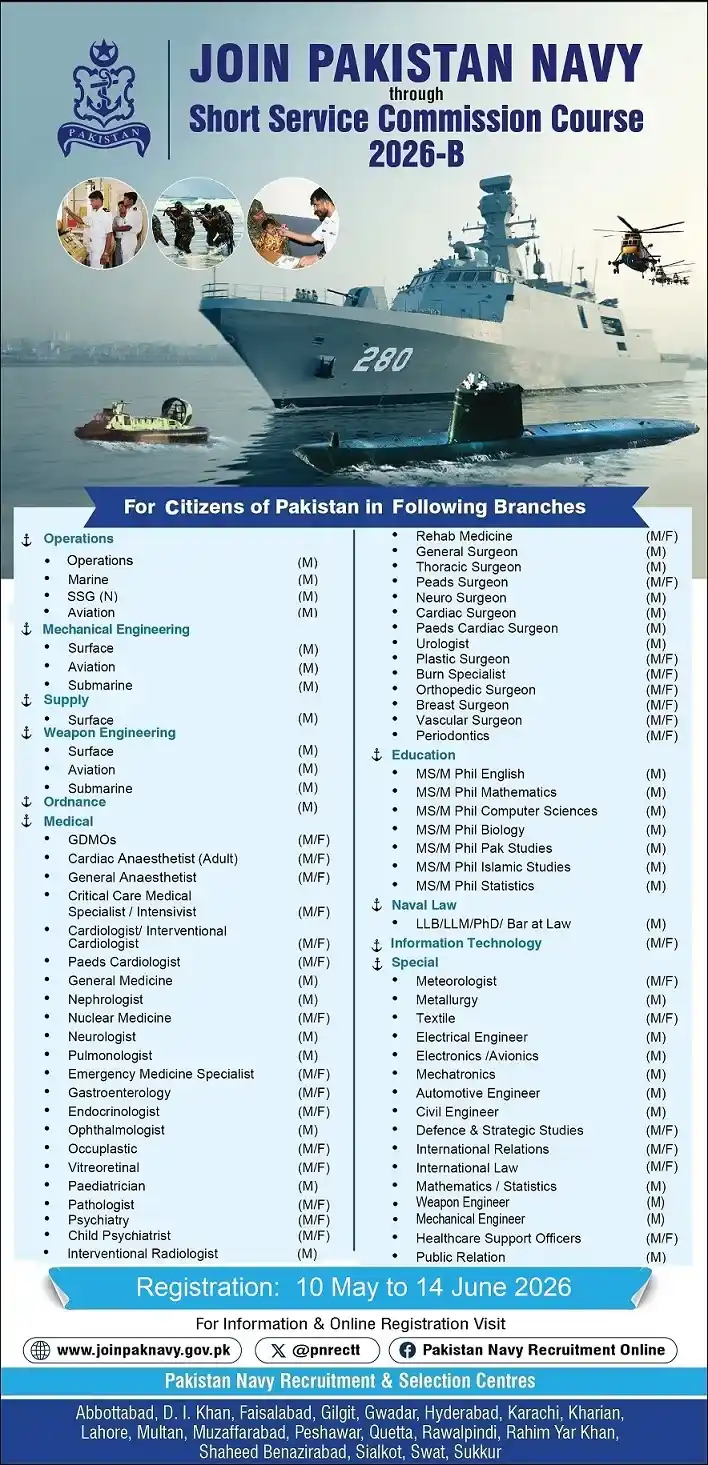
- Start Online Registration of Pak Navy SSC (Weapon Engineering Branch)= 10 May, 2026
- Last Date of Online Registration in Pak Navy Weapon Engineering Branch= 14 Jun, 2026
Eligibility Criteria of Pak Navy Weapon Engineering Branch
Eligibility criteria of Pak Navy Engineering branch is given below in detail for those who are going to choose serving in Pak Navy as a profession through Short Service Commission (SSC).
- Gender: Male
- Age: 22 to 26 Years
- Height: 5′ 4″ (Males)
- Educational Qualification: BE with Avionics / Electronics / Electrical (At least 2.5/4.0 CGPA or above
- Initial Rank: Sub Lt / Lt
Note: Candidates having 02 years work experience at Engineering / Industrial setup will be preferred.
Selection Process in Pak Navy Weapon Engineering Branch
The selection process for joining the Pakistan Navy’s Weapon Engineering Branch is comprehensive, designed to assess candidates’ technical capabilities, physical fitness, and suitability for a career in military engineering. Here’s a step-by-step overview of the typical selection procedure:
- Online Registration: The first step involves registering online through the official Pakistan Navy recruitment website. During this phase, candidates submit their personal and educational details. It’s important to check eligibility criteria closely as these can vary based on the specific needs of the Navy.
- Entrance Test: After registration, candidates are required to appear for an entrance test. The test typically includes sections on English, Mathematics, Physics, and General Knowledge, with an emphasis on engineering concepts to assess the candidate’s technical aptitude.
- Preliminary Medical Examination and Interview: Candidates who pass the entrance test undergo a preliminary medical examination at a designated Navy Recruitment and Selection Center. Those who meet the medical standards then proceed to an initial interview conducted at the same center.
- ISSB Tests: Candidates who successfully pass the preliminary stages are recommended for the Inter-Services Selection Board (ISSB) tests. The ISSB assessment includes psychological testing, group testing, and interviews. This stage is critical as it evaluates the candidate’s leadership potential, psychological fitness, and suitability for a career in the military.
- Final Medical Examination: Candidates who clear the ISSB tests undergo a final medical examination at a Military Hospital. This thorough medical check ensures that candidates are physically fit for military service.
- Final Selection: Final selection is based on the candidate’s performance across all the previous stages and is conducted by Naval Headquarters. Merit lists are compiled based on test scores, medical fitness, and overall performance during the ISSB.
- Training: Selected candidates are then enrolled at the Pakistan Naval Academy for basic training. This training combines physical conditioning, military education, and specialized engineering training tailored to the Weapon Engineering Branch.
- Commissioning: Upon successful completion of their training at the Naval Academy, candidates are commissioned as officers in the Weapon Engineering Branch of the Pakistan Navy.
Test Pattern & Syllabus of Pak Navy Weapon Engineering Branch
Following tests have been conducted in the initial tests of Pak Navy Engg branch, in which students have to secure more than 50% passing marks. If students score more high than other candidates then his/ her chances increases in the final selection merit list.
- Intelligence Test (Total Questions=100, Total Time=40 Min, pass mark=50%)
- Academic Test (Total Questions= 75 to 100, Total Time=35 to 40 Min, Pass mark=50%)
Free Weapon Engineering Jobs Questions
Following questions are given as per weapon engineering syllabus which neither helps to complete weapon engineering degree but also to get 100% marks in the initial tests of Pakistan Navy Short Commission exams.
Weapon Engineering Salary in Pak Navy starts from more than 70K at monthly basis.
Related: Past Papers of Pak Navy Weapon Engineering Branch with Answers
Role of Navy Weapon Engg Branch Officers
The Pakistan Naval Weapon Engg Branch fills in as the foundation of the maritime power, furnishing it with state of the art innovation and keeping up with the status of its battle frameworks. This branch comprises of exceptionally gifted architects, experts, and experts who work enthusiastically to guarantee that the maritime vessels and weapon frameworks capability impeccably. Their subject matters envelop different parts of weapon innovation, from surface-to-surface rockets to hostile to transport weaponry, furnishing the naval force with a vigorous and solid meditations stockpile.
The Evolution of Naval Weaponry: From Cannons to Guided Missiles
Throughout the long term, maritime fighting has seen wonderful changes in weaponry. Gone are the times of customary guns; present day maritime powers depend on modern directed rockets and progressed torpedoes. The Pakistan Naval Weapon Engg Branch has been at the very front of this development, keeping the naval force outfitted with cutting edge weaponry that guarantees its strength adrift.
Advancements in Naval Technology
As innovation progresses, so does the requirement for creative maritime frameworks. The Pakistan Naval Weapon Engineering Branch effectively takes part in innovative work to consolidate the most recent progressions in maritime innovation. It deals with Missile Guidance Systems, Stealth Technology for Naval Vessels, Cybersecurity in Naval Warfare, Unmanned Underwater Vehicles (UUVs) and Directed Energy Weapons (DEWs).
Ensuring Combat-Readiness: Regular Maintenance and Upgrades
Keeping up with the battle preparation of maritime vessels and weapon frameworks is of vital significance. The Pakistan Naval Weapon Engg Branch conducts customary support and overhauls of its gear to keep them in ideal condition. This proactive methodology guarantees that the Naval force is constantly ready to confront any expected dangers and difficulties in the sea space.
Enhancing Naval Power Projection: Role of Engineers at Sea
The Pakistan Naval Weapon Engineering department likewise conveys its specialists and specialized specialists on board maritime vessels. Their attendance adrift empowers them to offer quick help and investigating during basic tasks. Whether it’s diagnosing a designing issue or directing on-the-spot fixes, these gifted experts contribute altogether to improving the Naval force’s power projection abilities.
Join us at Social Media
Military Intelligence Test Preparation Portal
Prepare Army, Navy, and PAF initial tests online with our 2026 intelligence modules. Access comprehensive Verbal and Non-Verbal intelligence practice tests, premium PDF notes, and authentic past papers.
Army Navy PAF & Cadet Entry Success Hub
Optimize your preparation with our digital library. Download past PDFs, attend training video lectures, and access free E-books for military entrance success including ISSB guides.